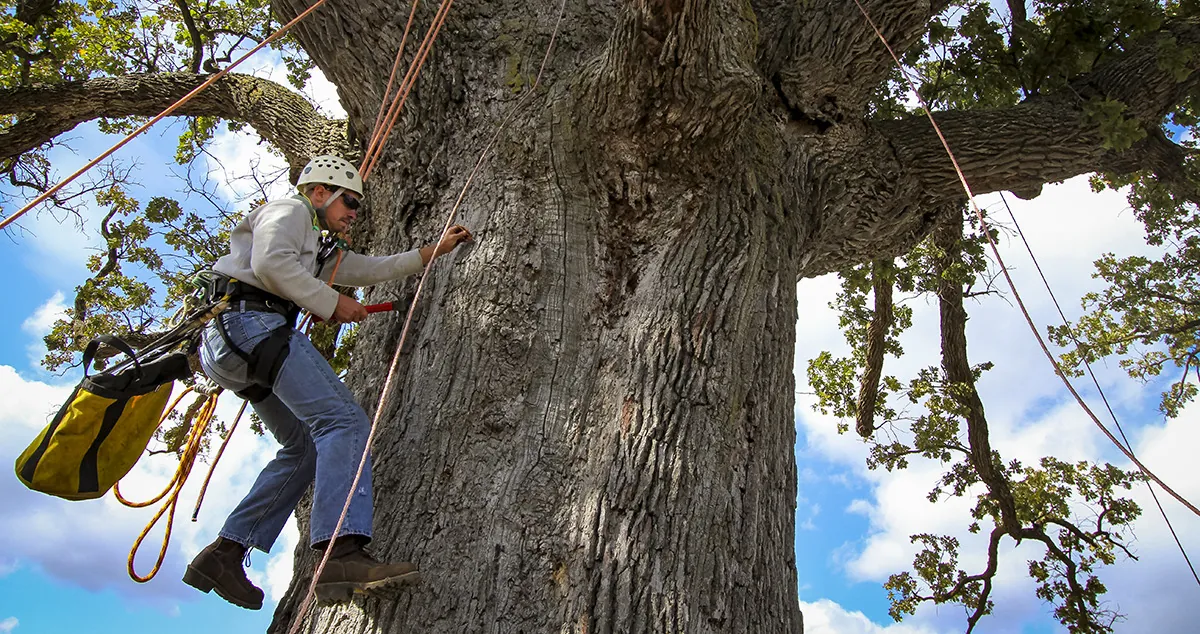
Near the small town of McBaine in Boone County, Missouri, a bur oak has been standing since before the United States existed. It is the Missouri State Champion of its species — the largest recorded bur oak in the state — and at more than 350 years old it has outlived every person who has ever tried to protect it.
We are among the arborists who care for it. That work is less dramatic than people expect, and far more deliberate.
What care looks like on a 350-year-old tree
The instinct with a famous tree is to do something impressive. The discipline is to do as little as possible, as precisely as possible. A tree that has survived three and a half centuries has already solved most of its own problems; the job is to remove the pressures it cannot solve and otherwise stay out of its way.
In practice that means proper fertilization matched to what the soil actually lacks rather than a standard blanket feed, pruning limited to what genuinely needs to come out, and deadwood removal — taking down limbs that have died and would otherwise fall on their own, at their own choosing, with a canopy this size overhead.
Every cut on a tree like this is a permanent decision. Bur oaks compartmentalise wounds slowly, and a mature specimen cannot regrow what a careless season removes. There is no version of this work that can be rushed.
Why lightning protection matters here
A large, isolated tree standing above open ground is, in electrical terms, the most attractive thing for miles. Lightning does not need to kill a tree outright to end it: a strike can blow a seam down the length of the trunk, cook the cambium, or open a wound that decay spends the next decade working through.
A lightning protection system gives the strike somewhere else to go. Copper conductors run from the upper canopy down the trunk and into the ground, carrying the current around the living tissue instead of through it. It is one of the few interventions in arboriculture where the cost is trivial next to what is being protected, and where doing nothing is a decision in itself.
For an irreplaceable specimen — a landmark tree, a memorial planting, the oak your house was built around — the same reasoning applies at any scale.
Recognition for the work
Our founder, Bill Spradley, is one of the few arborists in Missouri to have received a state proclamation from former Governor Jay Nixon for his work preserving the champion McBaine Bur Oak. He has also been recognised with the Missouri Arbor Award of Excellence, and received the International Society of Arboriculture’s True Professionals of Arboriculture award as one of only seven recipients worldwide.
Those are pleasant to have. What they actually reflect is a long argument, made repeatedly and in public, that old trees are worth the trouble — and that the trouble is mostly patience.
The same thinking, on ordinary trees
Very few people have a state champion in the yard. But the reasoning that keeps the McBaine oak standing is the same reasoning we bring to a seventy-year-old pin oak over a driveway in Kirkwood: understand what the tree is doing, find the pressures working against it, and remove those rather than reshaping the tree to suit a preference.
Most trees are lost long before they need to be — to construction damage nobody planned around, to soil compacted past the point roots can breathe, to a decade of pruning done for appearance. Those are all avoidable, and avoiding them is cheaper than any of the alternatives.
Have a tree worth keeping?
Our ISA-Certified Arborists can assess its condition, identify what is working against it, and tell you plainly what it needs — including when the answer is nothing at all.
Contact Us Our tree care services